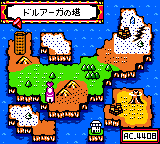
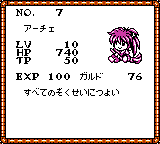
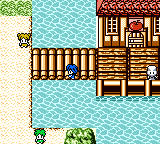
The year is AC 4395, and an inconspicuous meteor shoots across the sky of Aselia. When you (the invisible protagonist referred to by the narrator in second-person) go to where it lands, you find a pair of babies who you name Mel and Dio and adopt. 13 years later, soon after Dio has brought back home a pet he named Kurūru, a spirit called Norn appears in their house announcing to the two teenagers that they bear an original sin and their future is doomed. To avoid this future, they are allowed to prove themselves in trials against 12 spirits living in different time periods of Aselia.
This sequel to Tales of Phantasia game adopts a turn-based combat system, though the particulars of Narikiri Dungeon are uncommon even among Japanese RPGs. Though you technically have full control over all of your party members — being Mel, Dio, and Kurūru – the game by default only prompts you for decisions when it comes to the turn of the character you set as the party leader. The other two party members will automatically follow their configured strategies when their turns come up, unless you manually instruct them to do otherwise, which can be done at any time. Your instructions are not locked in until it’s actually their turn, which means you can revise your own instructions an arbitrary number of times, and only your last instruction before a turn comes up will be effective.
Outside of combat, Narikiri Dungeon’s gameplay sits somewhere between a typical Japanese RPG and a Roguelike. All dungeons in the game are procedurally generated, sparing a few puzzle floors which are handcrafted. The floor map gets updated as you explore. The only floor exit on a dungeon floor is the exit to the next floor (no backtracking) except for non-combat floors, which will sometimes have an exit out of the dungeon. Although the game doesn’t have permadeath, you can’t save your progress in the middle of a combat floor (only suspend the game), and you must go through the dungeon until you can reach a non-combat floor with a save point.
A significant part of the non-combat gameplay revolves around the costume system, which is similar in some respects to the job system of Final Fantasy V. Mel and Dio take on the role of whichever costume they wear and receive artes for that costume as they gain Costume Points from combat. Costumes can be gained mainly from two sources: Buying four baselines from costume shops and fusion. Costumes must be mastered by either Mel or Dio before they can be used for fusion. Some side quests (called Requests) also reward costumes. You can only change costumes at wardrobes, which are found in costume shops, your home, and non-combat floors in dungeons. Portable wardrobes can also be bought as one-time consumables to change costumes anywhere else on the spot.
The last major mechanic is “personality” meters, which rise and fall depending on the costumes Mel and Dio are wearing. These meters, along with costumes, only act as Request-clearing conditions for Mel & Dio, but for Kurūru, they are major mechanics. Kurūru shapeshifts depending on her personality bars, which influence her stats and lineup of artes. While you control Mel, Dio, and Kurūru in combat, you also play as Mel and Dio’s invisible adoptive parent. A significant input you make as their parent is answering their questions after each boss fight. These answers have the highest impact on their personality bars.
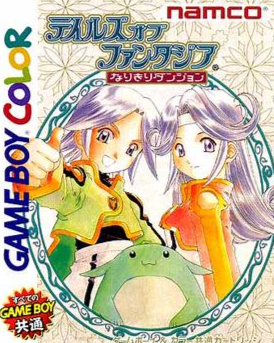
Cover Art:
Screenshots: