
I found myself going back in time once again to my 1980 Game List in order to play a game entitled Dungeon of Doom. A homicide detective would have labeled this “a cold case” as any copy of the game had been missing for years. A Youtuber, “DefaultGen”, uploaded it to the Internet Archive and I’ve now been able to play it.
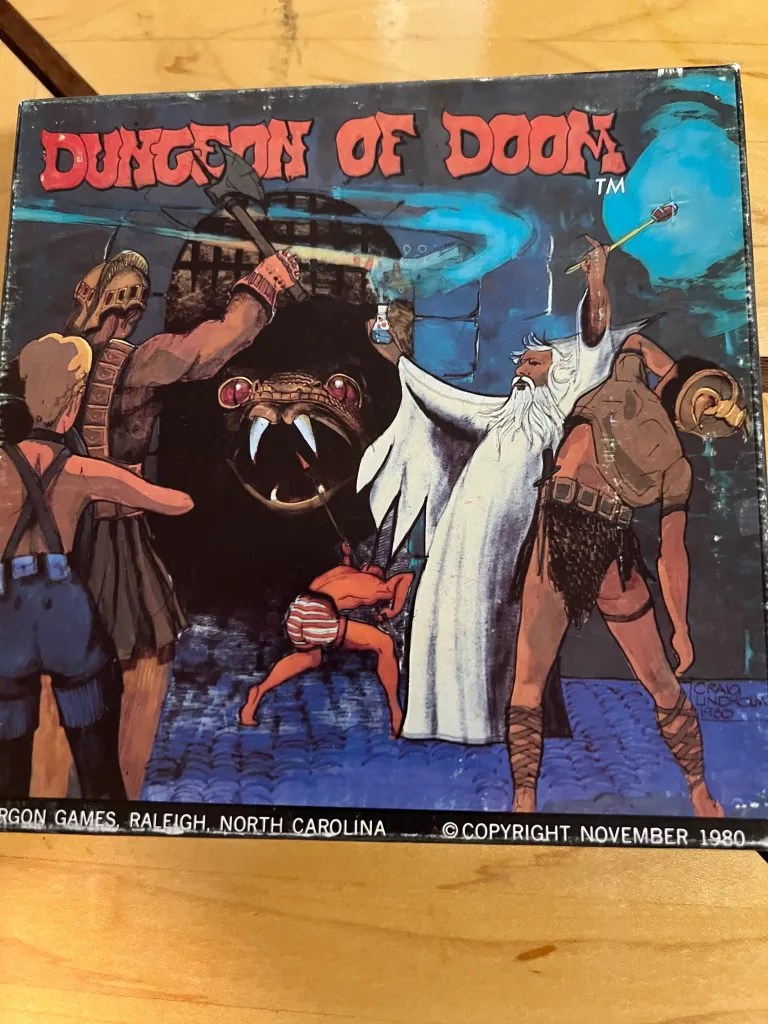
Dungeon of Doom was published in 1980 by Argon Games for the Apple II computer. The game was created by Stephen G. Walburn and Robert J. McCredie. They also created three board games for Argon between 1980 and 1981. Dungeon of Doom appears to have been their only computer title. Walburn handled the programming and McCredie contributed to the concept and design. Argon Games seems to have existed primarily for these titles and was a very small, independent publisher out of Raleigh, North Carolina. Walburn died of a heart attack in 1986.
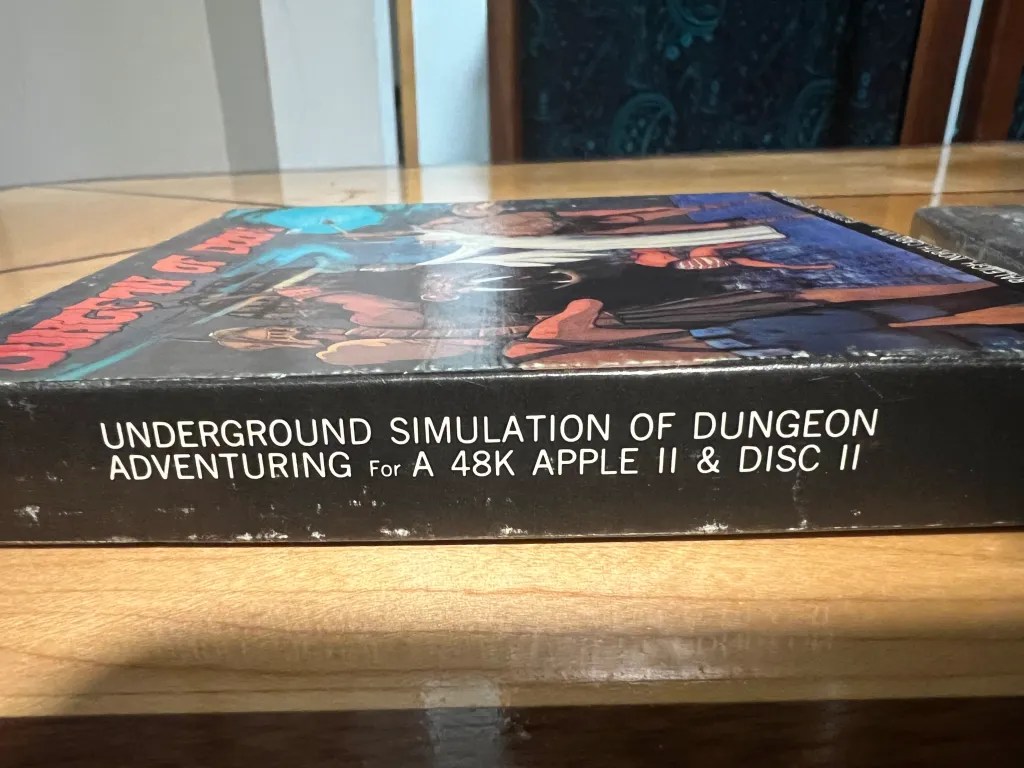
When the title screen appears, it asks if you want to use a previously saved party or create a new one. In this dungeon exploration game, you can actually create and control a party of up to 12 characters!

You can have any combination of fighter, mage, or cleric. Each character has six attributes: Strength, Dexterity, Constitution, Intelligence, Wisdom, and Charisma. Any Dungeons & Dragons fans are going to recognize these attributes. They all range between 3-18 but you can actually create a character with all 18s. You can also make the characters any level that you want and assign any hit point totals that you want. I made each of my characters level 20,000 with 999 hit points. It did not break the game and allowed me to do so. I was flabbergasted. When you assign equipment, you can give all armor and weapons up to a +5 magical bonus as well.
The game is interesting in that it works on the honor system. It assumes that you’re going to create a party of first level characters, do some exploring, slay a few monsters, find a few treasures, and then leave the dungeon. The (T)reasure key will inform you how much treasure you’re walking around with and how much experience you’ve earned. You’re supposed to record the experience and calculate for yourself whether your characters have made a level or not and then edit the number of their hit points accordingly.


I grudgingly went along with this method…..for awhile.

…and then I added an edited character to the party……and then progressed to creating five super characters at level 20,000 with 999 hit points apiece.
 Why? You’re right, this is so very uncharacteristic of me, so what gives? It turns out there is no plot of any kind nor is there any kind of story to set you up in the game’s MANUAL
There is no winning condition nor is there any need to map as the game provides the map for you.
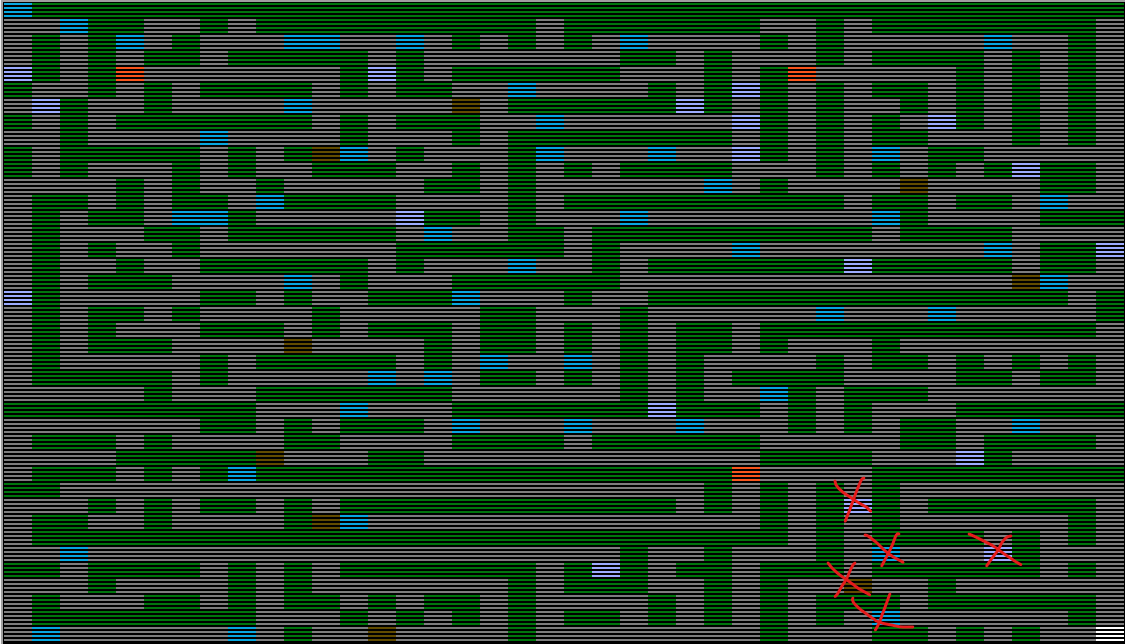
The dungeon consists of six levels and 78 rooms per level. The hallways and map configuration is always the same however the rooms, represented by the colored tiles, are randomly distributed. You always begin play in the lower SE corner and the doorway to the next level is in the upper NW corner. When you attempt to move to a lower level the game will warn you with a message that looks something like this; “only 48 of the 78 rooms have been cleared, are you sure you wish to proceed?” As you can see up above I methodically began checking off rooms as I explored them. Some of the rooms are empty and some of them contain encounters as well as treasure.

Dungeon exploration is in a first-person perspective. You move about using the F, B, L, and R keys on the keyboard. Each letter stands for Forward, Back, Left, and Right. Movement is rather odd in that when you choose to go (L)eft or (R)ight it turns you in that direction but also moves you a step forward in that direction as well. It took some getting used to. A positive is you’re not mapping each dungeon level by hand but that is also the game’s weakness as it takes away some of its charm as well. When you find yourself outside of a door on the map you hit the letter E to (E)nter the room. Pressing M will display the (M)ap of the current dungeon level. The following keys are also available:
- P – shows the group along with their current hit points
- T – Displays the group’s treasures
H – the cleric can heal party members. When you press this key the name of the cleric in your party must be typed in to access the menu with different levels of healing - C – you type in the name of your mage and you can then teleport to a different position in the maze
- Ctrl + N – this requires the password “1” and you can teleport up a level or down a level (the 1 or 2 keys respectively)
- Ctrl + P – displays your coordinates of the group’s tile within the current level. I never understood the significance of this since hitting the letter M to bring up the map always showed you your current location.
- Ctrl + R – asks whether you want to randomly reposition rooms on the current level you’re on. The advantage in doing this is that the deeper you travel in the dungeon the harder the battles become. If you’re choosing to play it straight this can be a boon because you can reset the first level and continue to grind to build up your characters before exploring the second level.
- Q – exits the game
Combat is both interesting and quite cumbersome. Once combat is initiated your view changes. If you’re in a room this is a gigantic 40 x 40 grid and if you’re in a hallway it’s a 20 x 40 grid. You battle one monster type only and the character icons are represented by different colors which you select for them during character creation. The manual claims that there are 141 different creature types. I didn’t stick around long enough to find out if this is true. Sometimes the creatures attack first, and other times the party gets to attack first. The game will cycle through each of the characters in order during their turn.

Your options during combat are movement, a melee attack, a ranged attack, or the casting of a spell. The 40×40 grid is just way too large. You will find that quite often one of your characters might be surrounded by the enemy while others are very far away. It becomes a slow and tedious process to begin moving each character towards the melee. There are nine different directions that characters can move during combat represented by the numbers 1-9.

Once combat is over, you’re awarded experience and/or treasure.
It is interesting to note that before the glorious debut of Wizardry: Proving Grounds of the Mad Overlord, it was initially believed that 1982’s Tunnel of Doom was the first game to offer multi-character combat. We now know that it is actually 1980’s Dungeon of Doom that now has that distinction. While this is an interesting footnote in the history of computer role-playing games, it does not make the experience of playing this game any more enjoyable.
I am extremely thankful that the “cold case” of this missing game was finally solved and that it’s place in the history of computer role-playing games is now firmly established. It was actually the first game to feature multiple characters in a party and also the first game to feature multiple characters in a top-down tactical combat grid. Because of these distinctions, I really wanted to enjoy the game but playing it felt more like a chore. The exploration and mapping choices, the slow speed of the game (the map took FOREVER to redraw and each combat took at least 15-20 minutes), and no plot or winning condition sucked all of the joy out of the game for me. I’d like to clarify what I meant by exploration and mapping choice. If each of the six dungeon levels were a mystery, and I had to draw them by hand, I might have (yes it would have been sheer insanity) mapped out a few of the levels. But since I can see the dungeon level, and the corridors remain the same but the rooms and their contents are random, it just removed any charm for me that the game might have had.
Thank you for taking the time to read me and for joining me on this journey. Until next time……